Backspam data

spam data

Bitcoin
2026-08-10 08:11:00

Bitcoin’s BIP-110 soft fork stalls after two blocks in eight hours

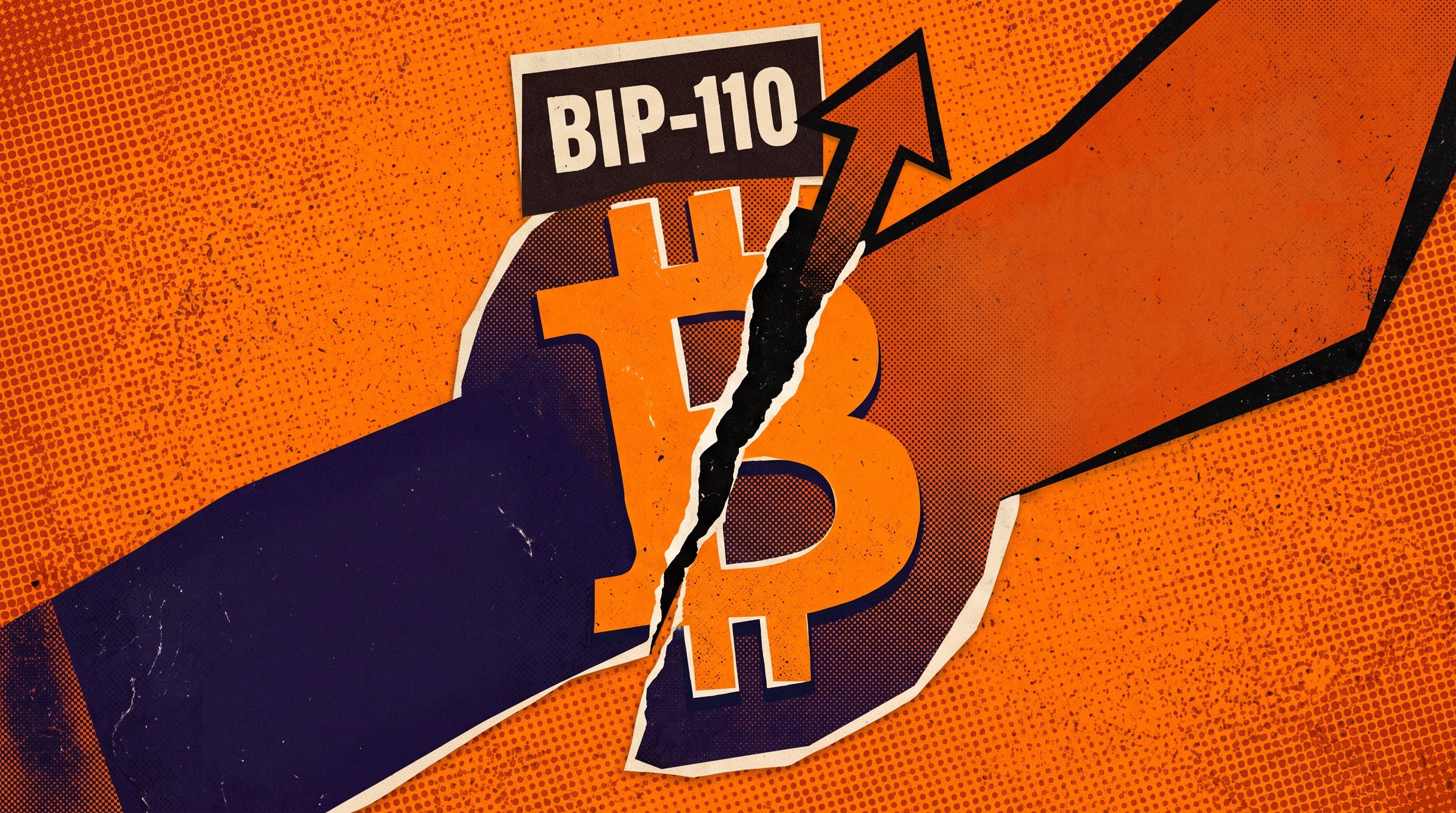
PANews reported that Bitcoin Improvement Proposal BIP-110 entered its mandatory signaling phase on August 9 but quickly ran into a wall. The minority chain tied to the proposal produced only two blocks in roughly eight hours, both mined by Roughnecks, after signaling support fell far short of the activation threshold. In the last difficulty period before activation, only 51 blocks signaled support, or about 2.53% of the 2,016-block window. Roughnecks and later PyBLOCK then paused support, while developer Luke Dashjr drew public criticism over the dispute.

2500
Bitcoin’s BIP-110 soft fork stalls after two blocks in eight hours
Bitcoin
2026-08-09 08:46:03

Adam Back pushes back on BIP-110 claims, says spam limits cannot be forced by soft fork

A dispute around Bitcoin Improvement Proposal 110, or BIP-110, is drawing attention in the Bitcoin community after the proposal sought to restrict non-financial data stored on the Bitcoin blockchain. Supporters of the proposal have been looking to push the rule change through a user-activated soft fork, or UASF, but miner backing is still well short of the activation threshold mentioned in the report. The debate has raised questions over whether it could turn into a broader governance split inside the Bitcoin network. Blockstream CEO Adam Back criticized arguments made by BIP-110 supporters in a post on X. He said the claim that “Bitcoin supports spam” is wrong and argued that no Bitcoin participant likes spam data on the network. Back also said Bitcoin cannot achieve absolute censorship at the mathematical level. In his view, BIP-110 has multiple flaws, would not operate effectively, and has therefore failed to win network consensus. He added that trying to push through rule changes without consensus could end in a split resembling Bitcoin SV, or BSV.

1830
Adam Back pushes back on BIP-110 claims, says spam limits cannot be forced by soft fork
Bitcoin
2026-08-09 02:20:50

Bitcoin’s BIP-110 enters mandatory signaling phase, but supporters fall onto a minority chain 26 blocks behind

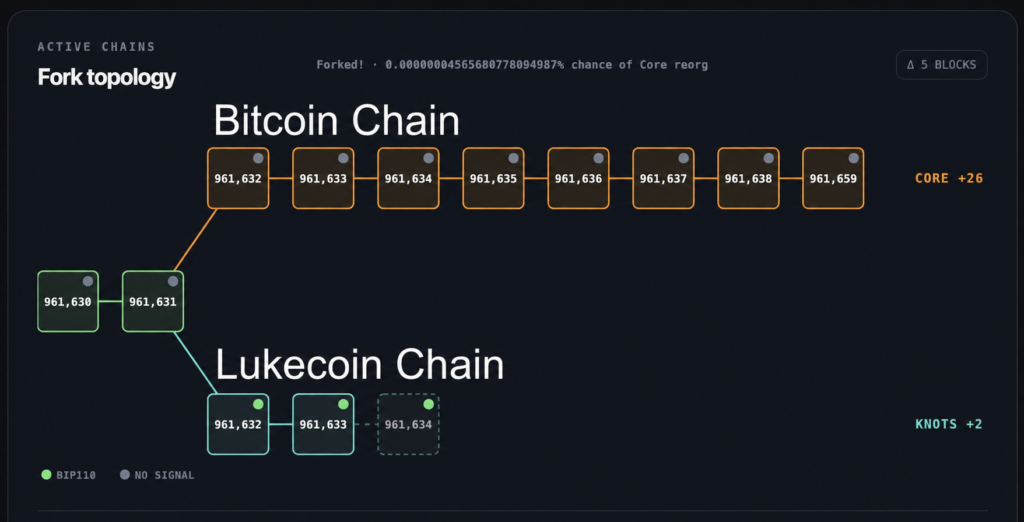
Bitcoin split into two branches at block 961,632 after BIP-110’s mandatory signaling phase went live, according to BlockTempo. The break was not a balanced network split but a sharp divergence in which BIP-110 nodes rejected non-signaling blocks and ended up following a minority chain. Miner support was reported at just 2.53% in the final signaling window before the split, far below the proposal’s 55% threshold. By 10 a.m. Taiwan time on Aug. 9, Bitcoin’s main chain had reached block 961,659, while the BIP-110 chain was stuck at 961,633, having produced only one additional block after the fork point. BIP-110, written by pseudonymous developer Dathon Ohm, proposes a temporary soft fork called “Reduced Data Temporary Soft fork” aimed at limiting non-financial data storage on Bitcoin for roughly one year. The proposal would restrict most new output scripts to 34 bytes, cap OP_RETURN outputs at 83 bytes, limit some data pushes and witness elements to 256 bytes, temporarily restrict certain Taproot functions, and exempt UTXOs created before activation. Critics including Adam Back, Jameson Lopp, and Michael Saylor have argued that the proposal lacks technical and ecosystem consensus and could create compatibility and chain-split risks. Market reaction was limited, with BTC trading around $65,000 and showing no clear volatility after the split.

1850
Bitcoin’s BIP-110 enters mandatory signaling phase, but supporters fall onto a minority chain 26 blocks behind
BIP-110
2026-08-08 11:58:42

BIP-110 Backed by Only 2.6% of Miners, Saylor Sees Stagnation or Irrelevance

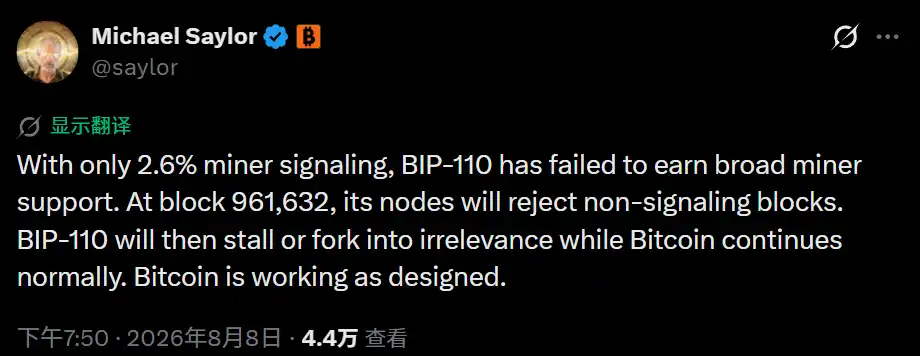
According to BlockBeats, on Aug. 8, Michael Saylor, founder of Strategy, said that only 2.6% of miners have signaled support for BIP-110, meaning the proposal has not gained broad support. In the same post, Saylor pointed out that at block height 961,632, nodes would reject blocks that do not signal in favor of BIP-110. He went on to say that after that point, BIP-110 would either stall or fork into an irrelevant existence, while Bitcoin itself would continue to run normally. 'Bitcoin is working as designed,' Saylor wrote. BIP-110 is a temporary soft fork proposal designed to add seven consensus restrictions over roughly a one-year period. Those restrictions include limiting new script public key lengths, placing caps on certain pushed data and witness item sizes, and disabling some Taproot extension paths. The proposal intends to substantially reduce arbitrary non-payment data that can be embedded in transactions, such as inscriptions and runes. This, in turn, would reduce the load on nodes, suppress spam data, and help Bitcoin stay focused on its role as money.

1650
BIP-110 Backed by Only 2.6% of Miners, Saylor Sees Stagnation or Irrelevance
BIP-110
2026-08-07 03:34:29

BIP-110 Mandatory Signaling Set to Begin in About 48 Hours

BIP-110 supporter Dathon Ohm said on X that mandatory signaling for BIP-110 will begin after about 290 blocks, or roughly 48 hours, at block height 961632. Miners will need to start signaling readiness or their blocks will be treated as invalid and discarded. Ohm also urged miners and users to upgrade to Bitcoin Knots nodes and said he does not recommend continuing to run Bitcoin Core, arguing that Core will become unsafe once mandatory signaling begins. Foresight News noted that BIP-110 is a Bitcoin improvement proposal aimed at limiting the size and method of arbitrary data embedded in Bitcoin transactions at the consensus layer, including Ordinals inscriptions, BRC-20 tokens, Runes, large OP_RETURN payloads, and some Taproot constructions used for data storage.

1740
BIP-110 Mandatory Signaling Set to Begin in About 48 Hours
Bitcoin
2026-07-25 13:50:02

PlanB opposes Bitcoin BIP-110, says fork backers misunderstand decentralization

PlanB said on July 25 that he opposes Bitcoin Improvement Proposal 110, or BIP-110, arguing that supporters of the fork do not fully understand three issues: Bitcoin is a decentralized bearer asset, Bitcoin enthusiasts dislike spam even more than they do, and the reasons the earlier Bitcoin Cash split failed. The proposal is framed as a temporary soft fork that would add seven consensus restrictions for roughly one year, including limits on new script public key length, parts of pushed data and witness item sizes, and the disabling of some Taproot extension paths. Its stated aim is to sharply reduce arbitrary non-payment data embedded in Bitcoin transactions, such as inscriptions and runes, cut node burden, curb spam data, and keep Bitcoin focused on monetary use. Miner support is currently about 1%, far below the 55% threshold required for passage, leaving its chances of becoming a formal Bitcoin main-chain rule very slim. A final outcome is expected around August 7 to 8, when the mandatory signaling window opens.

1360
PlanB opposes Bitcoin BIP-110, says fork backers misunderstand decentralization
IOSG
2026-07-14 01:32:50

IOSG says private AI is gaining ground as open models close the gap in cost and accuracy

IOSG argues that demand for private AI is rising across both enterprises and consumers as concerns over intellectual property leakage, data retention, and legal discovery become harder to ignore. The report maps the current privacy stack, from contract-based zero data retention and anonymous proxies to trusted execution environments, end-to-end encryption, fully homomorphic encryption, and local inference. Its main point is that the tradeoff is no longer as simple as privacy versus performance. A central example comes from Bridgewater’s AIA Labs and Thinking Machines. In a June 30 case study, an expert-tuned open model, Qwen3-235B, outperformed frontier models on financial judgment tasks while also delivering much lower inference cost. The model scored 84.7% on an independent test set, above an 80% threshold set by investment professionals. Frontier models averaged about 50% with simple prompts and reached 78.2% with expert prompting. By the report’s framing, the fine-tuned Qwen made 29.8% fewer mistakes than the best frontier baseline and ran at 13.8x lower inference cost. IOSG also says infrastructure for private inference and post-training is starting to mature. Enclave-based services from companies such as Phala, Tinfoil, and NEAR AI are pushing privacy costs down, in some cases to parity with or below plain-text routes. Still, major gaps remain in tool calling, agent workflows, and encrypted search, where privacy guarantees often break once requests leave the model layer.

1870
IOSG says private AI is gaining ground as open models close the gap in cost and accuracy
Private AI
2026-07-14 01:32:50

IOSG says private AI is gaining ground as open models close the gap in high-value enterprise work

IOSG argues that private AI is moving from a niche concern to a practical deployment choice for both enterprises and consumers. The report says the core issue is no longer abstract model safety, but where plaintext prompts, internal data, and company-specific judgment end up once they leave a user’s device. It reviews the current privacy stack, from contractual zero-data-retention and anonymous relays to trusted execution environments, end-to-end encrypted inference, fully homomorphic encryption, and local inference, and finds that costs and performance penalties are falling for several of these approaches. A central example comes from a June 30 case study by Bridgewater’s AIA Labs and Thinking Machines. In that work, an expert-tuned open model based on Qwen3-235B outperformed frontier models in both accuracy and inference cost on investment-related tasks, scoring 84.7% versus 78.2% for the best frontier setup using expert prompts, while cutting inference cost by 13.8x. IOSG’s argument is not that privacy AI is solved. Tool calls in agent workflows, encrypted search, and private post-training remain major gaps. But the report says the infrastructure needed to train and run open models inside controlled, attestable environments is arriving piece by piece, giving companies a clearer path to keep their own alpha inside their own boundary.

2420
IOSG says private AI is gaining ground as open models close the gap in high-value enterprise work